|
| |
| | 
Ficha bibliografica
| | | Código: | RECURSO ELECTRÓNICO [Biblioteca Lima] | | Ubicación: | Sede Principal | | Autor Personal: | Jakob, Michael;
Soria, Rafael;
Trinidad, Carlos;
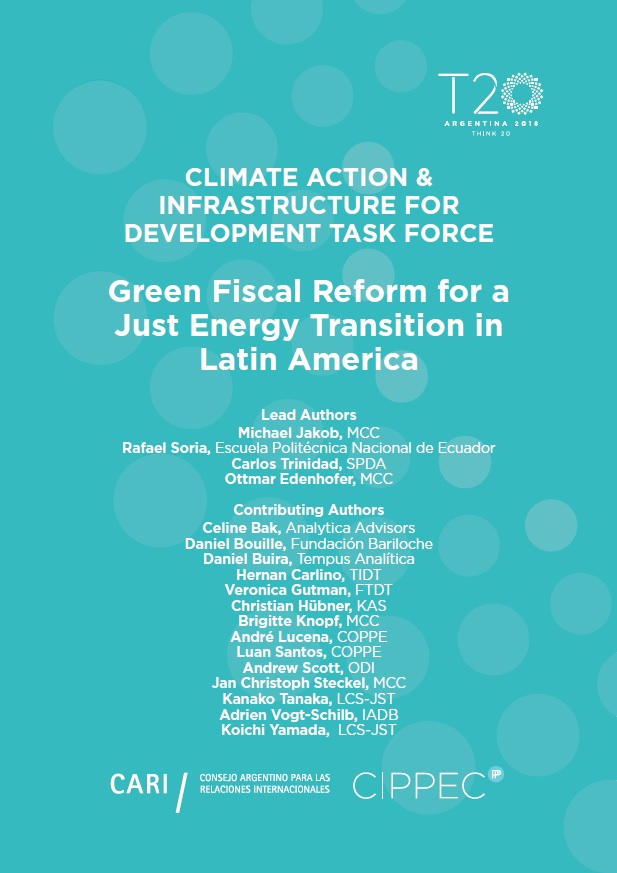
| | Título | Climate action and infrastructure for development task force: Green fiscal reform for a just energy transition in Latin America | | Ciudad:
| Buenos Aires | | Editorial:
| CARI; CIPPEC | | Año:
| 2018 | | Descripción: | 16 pág. | | Resumen: | Green fiscal reforms would contribute to climate change mitigation, increase the
economic efficiency of national tax systems and provide additional public revenues.
Policy makers need to ensure that the overall political and macro-economic conditions are favorable for green fiscal reforms and develop comprehensive reform plans. Reforms cannot usually be introduced directly; they require gradual introduction and appropriate policy sequencing. To avoid adverse impacts for the poorest sections of the population, it is crucial to understand the distributional impacts of higher energy prices and design appropriate compensation schemes. To ensure that all relevant social groups are fairly considered, transparency and stakeholder participation are crucial. International fora, such as the G20, can play a crucial role in sharing experiences on different design options, carrying out monitoring and peer-review of green fiscal policies, providing financial assistance and building administrative and institutional capacities. | | Palabras Claves: | ECONOMIA VERDE;
INFRAESTRUCTURA;
CAMBIO CLIMATICO;
| | Formatos: |  |
|
|
| Código: | RECURSO ELECTRÓNICO [Biblioteca Lima] | | 100: | Jakob, Michael; Soria, Rafael; Trinidad, Carlos | | 245 | Climate action and infrastructure for development task force: Green fiscal reform for a just energy transition in Latin America | | 260: | Buenos Aires: CARI; CIPPEC: 2018: | 300: | 16 pág. | | 520: | Green fiscal reforms would contribute to climate change mitigation, increase the
economic efficiency of national tax systems and provide additional public revenues.
Policy makers need to ensure that the overall political and macro-economic conditions are favorable for green fiscal reforms and develop comprehensive reform plans. Reforms cannot usually be introduced directly; they require gradual introduction and appropriate policy sequencing. To avoid adverse impacts for the poorest sections of the population, it is crucial to understand the distributional impacts of higher energy prices and design appropriate compensation schemes. To ensure that all relevant social groups are fairly considered, transparency and stakeholder participation are crucial. International fora, such as the G20, can play a crucial role in sharing experiences on different design options, carrying out monitoring and peer-review of green fiscal policies, providing financial assistance and building administrative and institutional capacities. | | 650: | ECONOMIA VERDE;INFRAESTRUCTURA;CAMBIO CLIMATICO | |
|
| Jakob, Michael; Soria, Rafael; Trinidad, Carlos. Climate action and infrastructure for development task force: Green fiscal reform for a just energy transition in Latin America. --Buenos Aires: CARI; CIPPEC: 2018. # Ingreso:19502 16 pág.
|
| Número Ingreso |
Código |
Título |
Base de Datos |
Ubicación |
Tipo |
# Ej. |
Status |
Devolución |
Reserva | | 19502 | RECURSO ELECTRÓNICO | Climate action and infrastructure for development task force: Green fiscal reform for a just energy transition in Latin America | Biblioteca Lima | Sede Principal | Original | 1 | Disponible |
|
|
|
|
|
|